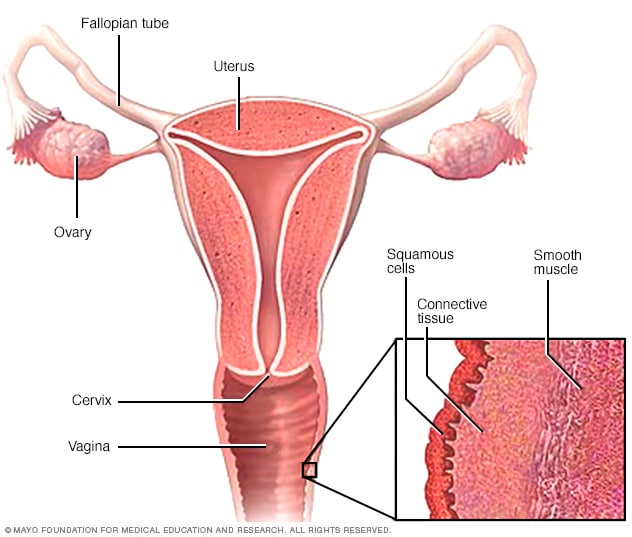
Vaginal cancer is a disease in which malignant (cancer) cells form in the vagina. Age and being exposed to the drug DES (diethylstilbestrol) before birth affect a woman’s risk of vaginal cancer. Signs and symptoms of vaginal cancer include pain or abnormal vaginal bleeding. The vagina is the canal leading from the cervix (the opening of uterus) to the outside of the body. At birth, a baby passes out of the body through the vagina (also called the birth canal).
Vaginal cancer is not common. There are two main types of vaginal cancer:
Squamous cell carcinoma: Cancer that forms in the thin, flat cells lining the inside of the vagina. Squamous cell vaginal cancer spreads slowly and usually stays near the vagina, but may spread to the lungs, liver, or bone. This is the most common type of vaginal cancer.
Adenocarcinoma: Cancer that begins in glandular cells. Glandular cells in the lining of the vagina make and release fluids such as mucus. Adenocarcinoma is more likely than squamous cell cancer to spread to the lungs and lymph nodes. A rare type of adenocarcinoma is linked to being exposed to diethylstilbestrol (DES) before birth. Adenocarcinomas that are not linked with being exposed to DES are most common in women after menopause.
For More Views: http://www.sciaeon.org/womens-health-and-complications/home
Article page: http://www.sciaeon.org/womens-health-and-complications/articles-in-press
Contribute your manuscript: http://www.sciaeon.org/submit-paper
For more queries: whc@sciaeonopenaccess.com

 Women's Health and Complications