Blog

Post-Partum Period

The postpartum period is commonly defined as the six weeks after childbirth. This is a very important time for both you and your newborn baby as you adjust to each other and your expanded family. In the first few hours and days after childbirth, you will experience many changes, both physically and emotionally. Over the next six weeks or so, your reproductive tract will slowly return to the way it was before you became pregnant. If you had a caesarean section, your recovery will be different from that of a vaginal delivery. Your breasts, which began enlarging during pregnancy, will be filled with a special clear fluid called colostrum for the first few days after childbirth. At first when your breasts fill with colostrum and then breast milk, your breasts may become enlarged, firm, and painful. This is called breast engorgement, and it should disappear after a few days. Try to persevere with breastfeeding during this time, as breast milk is the ideal food for your newborn baby.
For more: http://sciaeon.org/womens-health-and-complications/home

Submit your manuscript: http://sciaeon.org/submit-paper

Contact us: whc@sciaeonopenaccess.com
Normal Labour

Normal labour is defined as term pregnancy with spontaneous onset of labor, with a vertex fetal presentation, vaginal delivery and normal neonatal outcomes. Normal labor is a retrospective diagnosis. Usually the onset of labour is associated with painful uterine contractions palpated per abdomen, with progressive cervical dialatation with effacement. Rupture of the membranes are not essential for the diagnosis of onset of labour. Normal labour is divided into three phases. First phase starts from the first cervical dialatation upto the fullest dialatation of the cervix. Second phase is from the full dialatation of the cervix to the delivery of the fetus and third stage of labour is the time from the birth of the baby to the expulsion of the placenta and membranes.

For more: http://sciaeon.org/womens-health-and-complications/home

Submit your manuscript: http://sciaeon.org/submit-paper

Contact us: whc@sciaeonopenaccess.com
Aging

Aging, progressive physiological changes in an organism that lead to senescence, or a decline of biological functions and of the organism’s ability to adapt to metabolic stress. Aging takes place in a cell, an organ, or the total organism with the passage of time. It is a process that goes on over the entire adult life span of any living thing. Gerontology, the study of the aging process, is devoted to the understanding and control of all factors contributing to the finitude of individual life. It is not concerned exclusively with debility, which looms so large in human experience, but deals with a much wider range of phenomena. Every species has a life history in which the individual life span has an appropriate relationship to the reproductive life span and to the mechanism of reproduction and the course of development.

For more: http://sciaeon.org/womens-health-and-complications/home

Submit your manuscript: http://sciaeon.org/submit-paper

Contact us: whc@sciaeonopenaccess.com
Menopause

Menopause is a natural biological process. But the physical symptoms, such as hot flashes, and emotional symptoms of menopause may disrupt your sleep, lower your energy or affect emotional health. There are many effective treatments available, from lifestyle adjustments to hormone therapy. Symptoms, including changes in menstruation, are different for every woman. Skipping periods during perimenopause is common and expected. Often, menstrual periods will skip a month and return, or skip several months and then start monthly cycles again for a few months. Periods also tend to happen on shorter cycles, so they are closer together. Despite irregular periods, pregnancy is possible. If you’ve skipped a period but aren’t sure you’ve started the menopausal transition, consider a pregnancy test.

For more: http://sciaeon.org/womens-health-and-complications/home

Submit your manuscript: http://sciaeon.org/submit-paper

Contact us: whc@sciaeonopenaccess.com
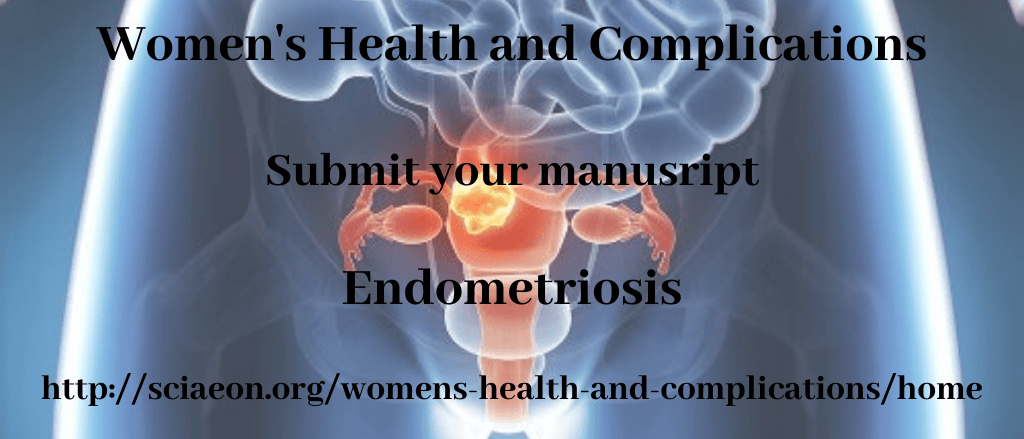
Endometriosis

Endometriosis is a disorder in which tissue similar to the tissue that forms the lining of your uterus grows outside of your uterine cavity. The lining of your uterus is called the endometrium. Endometriosis occurs when endometrial tissue grows on your ovaries, bowel, and tissues lining your pelvis. It’s unusual for endometrial tissue to spread beyond your pelvic region, but it’s not impossible. Endometrial tissue growing outside of your uterus is known as an endometrial implant. The hormonal changes of your menstrual cycle affect the misplaced endometrial tissue, causing the area to become inflamed and painful. This means the tissue will grow, thicken, and break down. Over time, the tissue that has broken down has nowhere to go and becomes trapped in your pelvis.

For more: http://sciaeon.org/womens-health-and-complications/home

Submit your manuscript: http://sciaeon.org/submit-paper

Contact us: whc@sciaeonopenaccess.com
Cervical Cancer

Cervical cancer is cancer that starts in the cervix, the narrow opening into the uterus from the vagina. The normal ectocervix (the portion of the uterus extending into the vagina) is a healthy pink color and is covered with flat, thin cells called squamous cells. The endocervix or cervical canal is made up of another kind of cell called columnar cells. The area where these cells meet is called the transformation zone (T-zone) and is the most likely location for abnormal or precancerous cells to develop. Many women with cervical cancer don’t realize they have the disease early on, because it usually doesn’t cause symptoms until the late stages. When symptoms do appear, they’re easily mistaken for common conditions like menstrual periods and urinary tract infections (UTIs). Most cervical cancer cases are caused by the sexually transmitted human papillomavirus (HPV). This is the same virus that causes genital warts.

For more: http://sciaeon.org/womens-health-and-complications/home

Submit your manuscript: http://sciaeon.org/submit-paper

Contact us: whc@sciaeonopenaccess.com
Birth Control

Birth control, also known as contraception, is designed to prevent pregnancy. Birth control methods can be broadly classified into barrier methods, methods that prevent ovulation such as the birth control pill, and methods that allow fertilization of the egg but prevent implantation of the fertilized egg inside the uterus. A range of devices and treatments are available for both men and women that can help prevent pregnancy. Some methods are more reliable than others. How well a method work often depends on how carefully it is used. The contraceptive pill, for example, used correctly, is over 99 percent effective. However, because people make mistakes, as many as 9 women each year will become pregnant while using it.

For more: http://sciaeon.org/womens-health-and-complications/home

Submit your manuscript: http://sciaeon.org/submit-paper

Contact us: whc@sciaeonopenaccess.com
Abortion

Abortion is when a pregnancy is ended so that it doesn’t result in the birth of a child. Sometimes it is called ‘termination of pregnancy‘. Abortion, the expulsion of a fetus from the uterus before it has reached the stage of viability. An abortion may occur spontaneously, in which case it is also called a miscarriage, or it may be brought on purposefully, in which case it is often called an induced abortion. Spontaneous abortions, or miscarriages, occur for many reasons, including disease, trauma, genetic defect, or biochemical incompatibility of mother and fetus. Occasionally a fetus dies in the uterus but fails to be expelled, a condition termed a missed abortion. Unsafe abortion occurs when a pregnancy is terminated either by persons lacking the necessary skills or in an environment that does not conform to minimal medical standards or both. Unsafe abortion procedures may involve the insertion of an object or substance into the uterus; dilatation and curettage performed incorrectly by an unskilled provider; ingestion of harmful substances; and application of external force.

For more: http://sciaeon.org/womens-health-and-complications/home

Submit your manuscript: http://sciaeon.org/submit-paper

Contact us: whc@sciaeonopenaccess.com
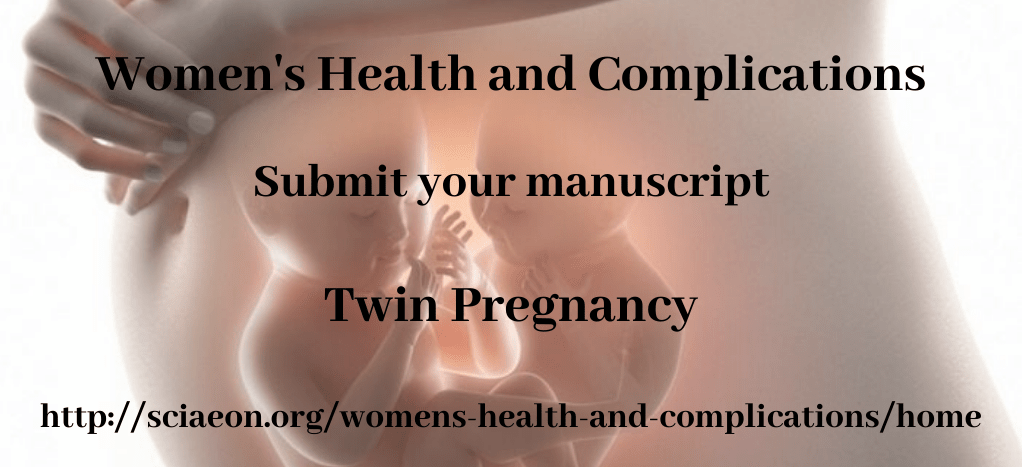
Twin Pregnancy

Twins can develop from one ovum (egg) or from two ova (eggs). Twins who develop from a single ovum are called monozygotic or identical twins. They have identical genomes. Twins who develop from two ova that are fertilized at the same time are called dizygotic or fraternal twins. They are nonidentical and have different genomes. A twin pregnancy comes with risks, both for the mother and the babies. Some moms hope to conceive twins or even higher-order multiples and will take active steps during fertility treatment to increase their odds. Other moms do what they can to avoid conceiving twins, but still get pregnant with more than one baby.

For more: http://sciaeon.org/womens-health-and-complications/home

Submit your manuscript: http://sciaeon.org/submit-paper

Contact us: whc@sciaeonopenaccess.com
Ectopic Pregnancy

Ectopic pregnancy is when a pregnancy grows outside of your uterus, usually in your fallopian tube. Ectopic pregnancies are rare but serious, and they need to be treated. Ectopic pregnancy is when a fertilized egg attaches somewhere else in your body, usually in your fallopian tube — that’s why it’s sometimes called tubal pregnancy. Ectopic pregnancies can also happen on your ovary, or somewhere else in your belly. The three symptoms of ectopic pregnancy are abdominal pain, absence of menstrual periods, and vaginal bleeding.

For more: http://sciaeon.org/womens-health-and-complications/home

Submit your manuscript: http://sciaeon.org/submit-paper

Contact us: whc@sciaeonopenaccess.com