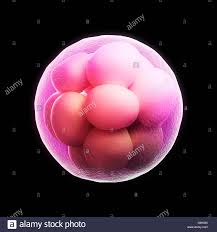
A morula is an early-stage embryo consisting of 16 cells (called blastomeres) in a solid ball contained within the zona pellucida. A morula is distinct from a blastocyst in that a morula is a mass of 16 totipotent cells in a spherical shape whereas a blastocyst has a cavity inside the zona pellucida along with an inner cell mass. A morula, if untouched and allowed to remain implanted, will eventually develop into a blastocyst. The morula is produced by a series of cleavage divisions of the early embryo, starting with the single-celled zygote. Once the embryo has divided into 16 cells, it begins to resemble a mulberry, hence the name morula. Within a few days after fertilization, cells on the outer part of the morula become bound tightly together with the formation of desmosomes and gap junctions, becoming nearly indistinguishable. This process is known as compaction. The cells on the outside and inside become differentially fated into trophoblast (outside) and inner cell mass (inside) progenitors. A cavity forms inside the morula, by the active transport of sodium ions from trophoblast cells and osmosis of water. This results in a hollow ball of cells known as the blastocyst.
For More Views: http://www.sciaeon.org/womens-health-and-complications/home
Article page: http://www.sciaeon.org/womens-health-and-complications/articles-in-press
Contribute your manuscript: http://www.sciaeon.org/submit-paper
For more queries: whc@sciaeonopenaccess.com

 Women's Health and Complications